
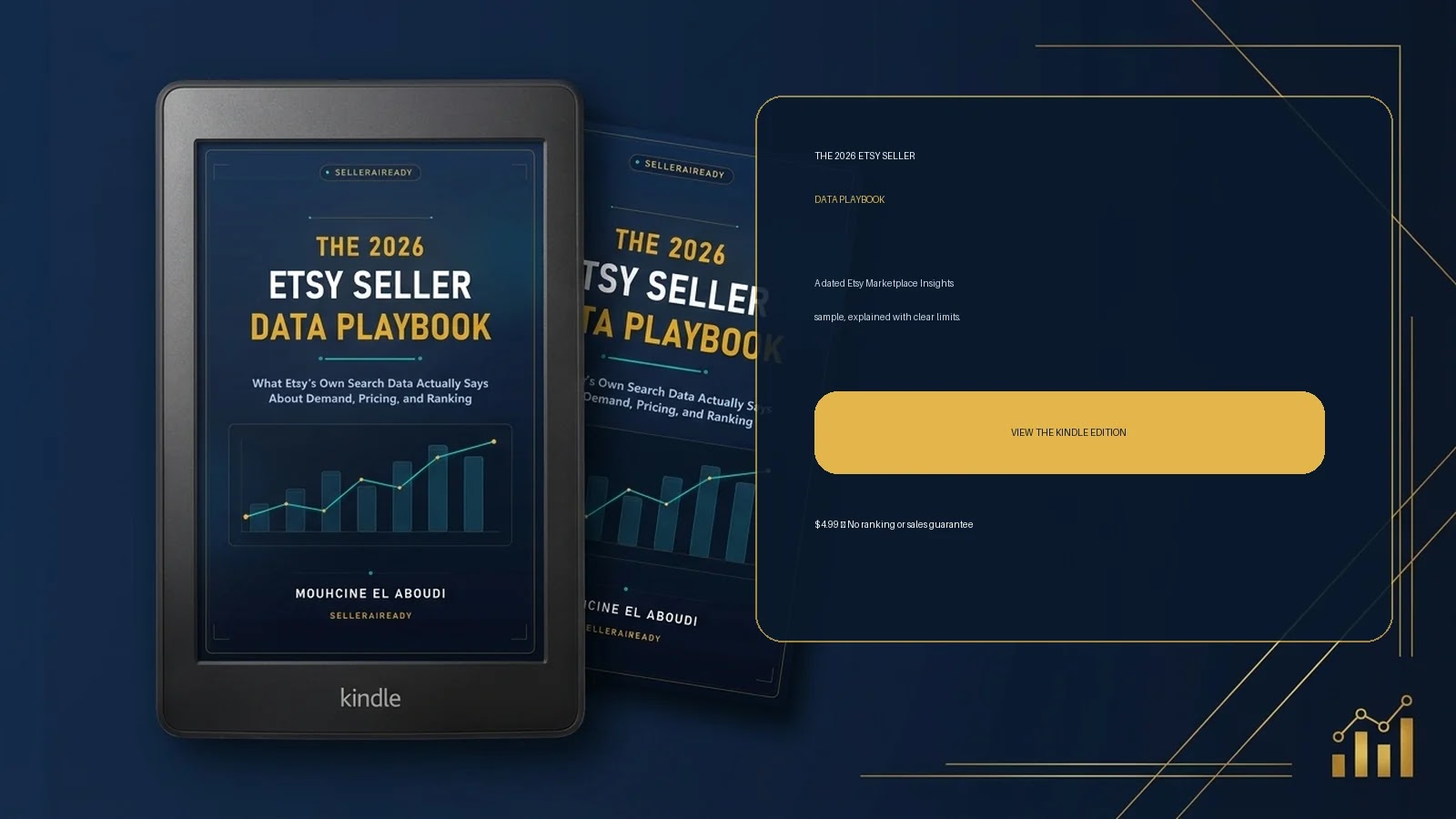
The 2026 Etsy Seller Data Playbook is a practical Kindle guide for sellers who want to make clearer listing decisions without relying on guesses, hype, or one-size-fits-all rules. It shows how to read marketplace signals, organize research, and turn observations into small, measurable tests.
If you have ever opened your shop dashboard, seen a mix of views, favorites, and quiet listings, and wondered what to change first, this book was written for that exact moment. It does not promise instant ranking or guaranteed sales. Instead, it gives you a repeatable way to decide what the available evidence may be telling you—and what it cannot prove yet.
View The 2026 Etsy Seller Data Playbook on Amazon Kindle
What is The 2026 Etsy Seller Data Playbook?
It is a step-by-step decision guide for Etsy sellers who want to use data more carefully. The focus is not on chasing every new tactic. The focus is on building a simple research habit: observe a signal, form a reasonable hypothesis, change one meaningful variable, and measure what happens next.
The book is especially useful when you are dealing with questions such as:
- Is a listing failing to attract attention, or is it attracting the wrong visitors?
- Should the next test involve the thumbnail, title, offer, price presentation, or description?
- How much evidence is enough before making another change?
- How can AI help with research without replacing seller judgment?
- Which numbers matter for the decision in front of you?

Why seller data needs context
A number by itself rarely explains the whole story. A listing can receive impressions without clicks, clicks without purchases, or favorites without an order. Each pattern may suggest several possible explanations. The useful question is not “What does this number always mean?” but “What is the most reasonable next test based on the evidence I have?”
For example, low click activity may justify reviewing the first image, title clarity, or search intent. Visits without purchases may justify checking offer clarity, trust signals, shipping expectations, price presentation, or product-market fit. None of those signals proves a single cause on its own, which is why controlled testing matters.
What you will learn
1. Build a cleaner research workflow
The book explains how to separate useful evidence from noise. You will learn to record what you observed, where the information came from, what changed, and when you will review the result. This creates a decision trail instead of a collection of disconnected edits.
2. Diagnose before you rewrite
Rewriting an entire listing every time performance slows makes it difficult to know what helped. The playbook encourages focused changes: identify the stage that may be weak, select one high-impact variable, and give the test enough time and qualified traffic to become informative.
3. Use a six-block product-description structure
The guide includes a six-block product-description structure designed to help sellers present the product, buyer, benefits, important details, expectations, and next step clearly. It is a writing framework—not a guarantee of conversion or marketplace visibility.
4. Use AI as an assistant, not an autopilot
AI can help summarize research, compare wording, organize attributes, and produce alternatives. It still needs accurate inputs and human review. The seller remains responsible for product facts, compliance, customer expectations, and the final publishing decision.

Who is this Kindle guide for?
This book is designed for new and developing Etsy sellers, digital-product creators, handmade-business owners, and experienced sellers who want a more disciplined way to review listing performance. It can also help anyone who uses AI tools for listing research but wants a process that keeps factual accuracy and human judgment in control.
It may be a good fit if you:
- feel overwhelmed by conflicting Etsy advice;
- change several listing elements at once and cannot tell what worked;
- want a practical system rather than a collection of “secret hacks”;
- need a clearer way to connect research with action;
- prefer cautious, evidence-led decisions over unsupported promises.
A simple way to use the playbook
- Choose one decision. Start with a specific question, such as whether the first image communicates the product quickly.
- Record the baseline. Save the relevant numbers and the current listing version before changing anything.
- Form a hypothesis. State what you think may improve and why.
- Change one meaningful variable. Avoid editing the thumbnail, title, price, and description at the same time.
- Review qualified evidence. Look at the visitors and actions that are relevant to the test, not vanity numbers alone.
- Keep, revise, or stop. Make the next decision from the result instead of from impatience.
This cycle cannot guarantee a particular outcome, but it makes your decisions easier to explain, compare, and improve.
How this supports SEO, AEO, and AI-assisted discovery
Clear product information benefits people first. It can also make content easier for search engines and answer systems to understand. Useful practices include descriptive headings, direct answers, accurate product terminology, meaningful image alt text, concise definitions, and links that help readers verify or continue the topic.
That does not mean any page can be guaranteed a number-one ranking. Search visibility depends on competition, relevance, authority, technical quality, user response, and changes made by each platform. The goal here is to create a genuinely useful resource with a clear subject and strong internal context—not to stuff keywords into every paragraph.
Frequently asked questions
Does the book guarantee more Etsy sales?
No. It provides a structured way to research, test, and make decisions. Results vary by product, market, offer, execution, traffic quality, and other factors outside the book’s control.
Is the book only for experienced sellers?
No. The process is written to be usable by newer sellers while still giving experienced shop owners a cleaner framework for testing and documentation.
Does it teach a product-description framework?
Yes. It includes a six-block product-description structure that helps organize essential buyer information clearly.
Can I use the workflow with AI tools?
Yes. The workflow can help you give AI better context and review its output more carefully. Always verify facts, policies, and product details before publishing.
Where can I get the book?
The Kindle edition is available on Amazon under ASIN B0HHC3W8XB. The displayed price may vary by marketplace and over time.
Start with one better decision
You do not need to rebuild your entire shop in one day. Choose one listing, identify one decision, and begin with a clear baseline. A consistent research process is more useful than a burst of random edits.
Get The 2026 Etsy Seller Data Playbook on Kindle
For related resources, visit the SellerAIReady Start Here page, use the free Etsy listing checklist, or read what Etsy listing views without sales may indicate.
SellerAIReady Publishing. Educational information only. Etsy and Amazon are trademarks of their respective owners; SellerAIReady is not affiliated with or endorsed by either company.